No. 34 Distraction Fallacies
Nirvana Fallacy
In Turkish: Mükemmel Çözüm Safsatası
It doesn’t fix everything, so you count it as fixing nothing. Put the belt on.
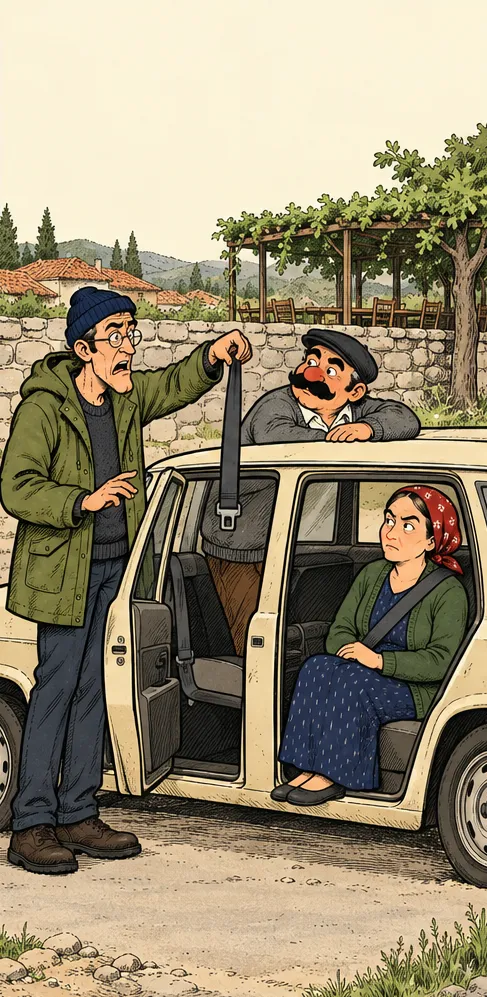
You crash with a belt on too. It doesn’t prevent the crash, so what’s the point?

He’s right. I’m not wearing mine either, it just digs in.

The belt doesn’t prevent the crash, it stops you flying through the windscreen. Both of you, belts on, or I’m getting out.
What is it?
Rejecting a solution because it isn’t perfect: acting as if something that doesn’t end the whole problem does nothing at all. In the real world a solution is compared with the other solutions we have, not with the flawless one we imagine.
The pattern
- X doesn’t solve the problem completely.
- Therefore X is useless. (Or: let’s not do X.)
Why it fails
One side of the comparison is real and the other is imaginary, and the imaginary side always wins. A seatbelt doesn’t save you in every crash, a vaccine doesn’t protect everyone, a diet doesn’t shed every kilo; but each beats doing nothing, and that is the real comparison. This fallacy serves whoever doesn’t want to act: waiting for the perfect solution is also a choice, and usually the worst one.
How to spot it
- The solution is compared with a flawless fantasy, not with the other solutions.
- Phrases like “it doesn’t solve it completely”, “it’ll still happen”, “it isn’t a hundred percent”.
- Nothing is proposed in place of the rejected solution; usually nothing gets done.
What to say
Drag the comparison back to earth: “Compare it with what we have, not with perfection. What happens if we don’t do this?” Then ask for numbers: “Fine, it doesn’t solve it all; how much does it solve?” Something that solves half beats something that solves nothing.
When it’s not a fallacy
Showing that a solution falls short and proposing a better one isn’t a fallacy; it’s exactly what should happen. So is showing that a solution costs more than it’s worth. The fallacy is throwing out the imperfect without pointing to anything concrete that is better.
Examples
- Health“I won’t get the flu jab, people who get it still catch flu.” They do; less often and more mildly. The comparison isn’t “jab versus no flu”, it’s “jab versus no jab”.
- Work“The new system doesn’t eliminate errors entirely, so let’s stick with the old one.” The new one eliminates half of them; the old one eliminates none.
- Traffic“Speed cameras don’t bring accidents to zero, waste of money.” If a camera cuts accidents by thirty percent it isn’t a waste; nothing brings them to zero.
- Family“What’s the point of a screen-time limit, the kid will still watch.” One hour a day of watching and six hours are not the same thing.